// defensive security · whitecliffe mc1a · 2026
Cyber Technician lab portfolio
I completed every exercise in all 22 EC-Council Certified Cybersecurity Technician lab modules, as part of Whitecliffe's Level 6 Cyber Technician micro-credential. For the assessed portfolio I documented ten of them screenshot by screenshot, then used them to design a security and disaster recovery strategy for a real-world scenario.
Monitoring: catching the attack in the SIEM
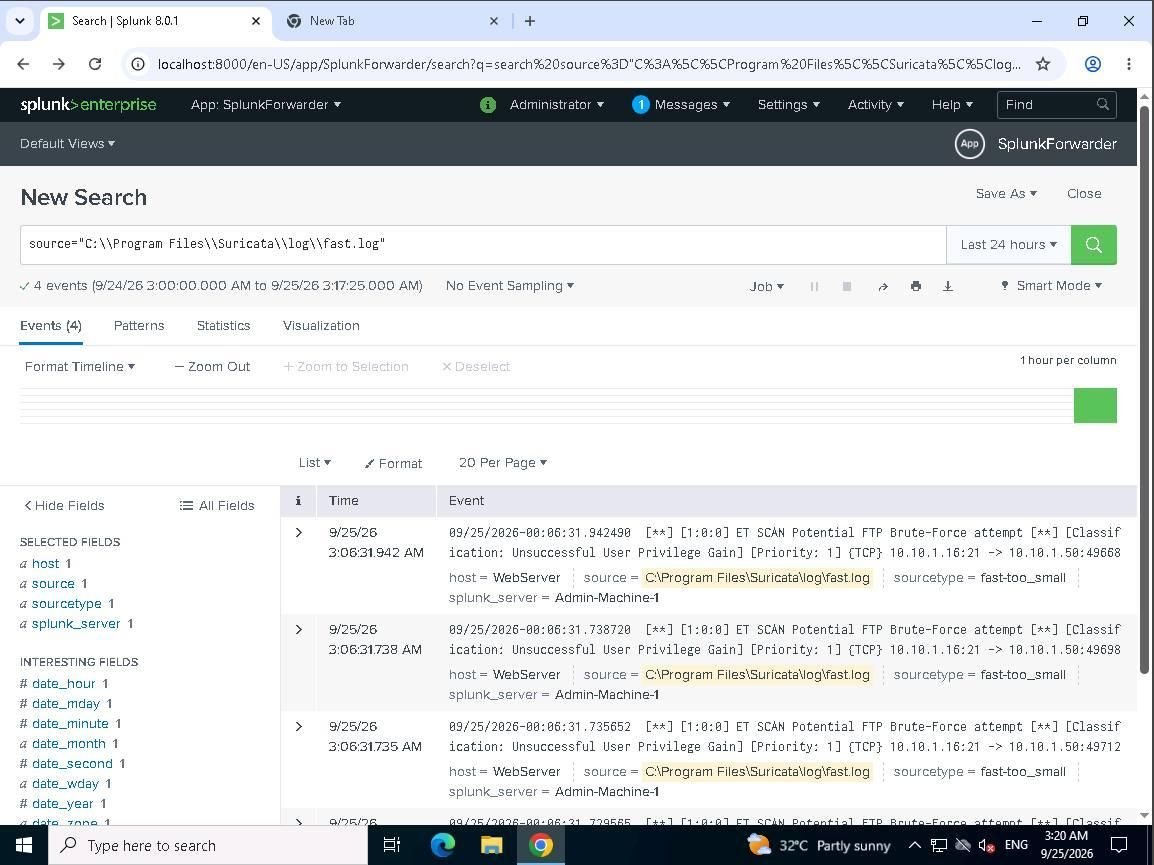
The most involved exercise was running Suricata as a network intrusion detection system and forwarding its alerts into Splunk. The final search pulled the Suricata log and surfaced repeated "potential FTP brute-force" alerts from a single attacker, then charted them over time. Getting there took a lot of resets, and taught me to verify each hop: is the sensor seeing traffic, is the forwarder shipping it, is the index receiving it.
Assessment: finding what's exposed
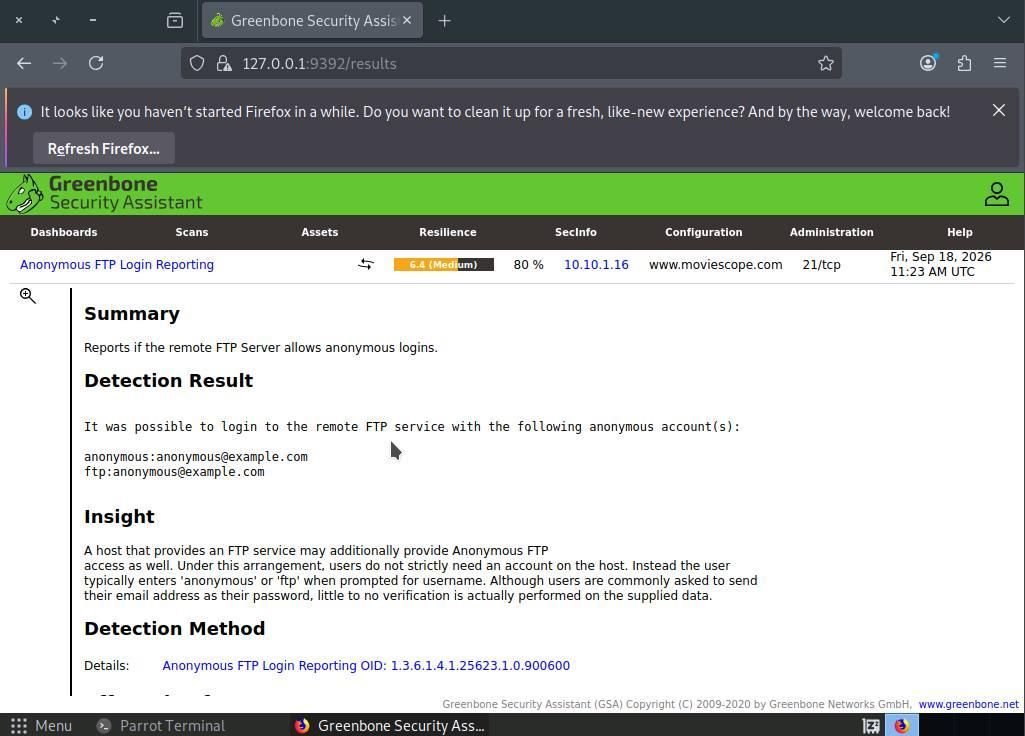
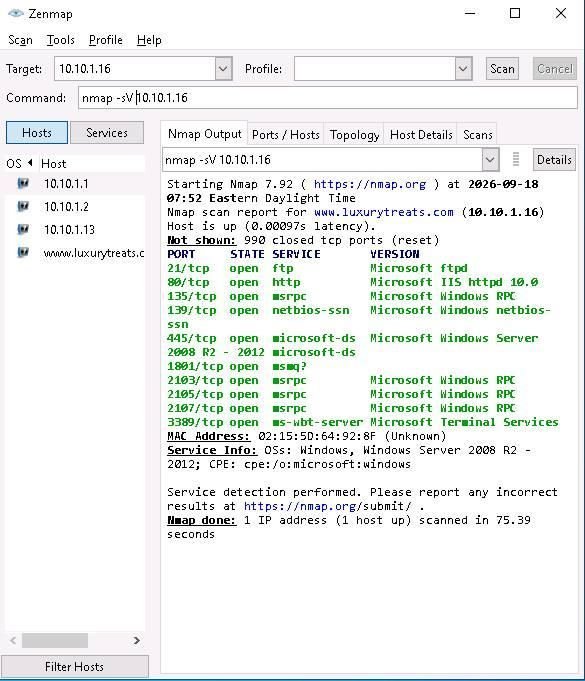
OpenVAS flagged anonymous FTP access on the target. Nmap confirmed the open services and showed SMB signing disabled. CWE research turned the finding into a root cause, CWE-306 Missing Authentication, which is what a fix has to address.
The ten documented exercises
Vulnerability assessment with OpenVAS
Scanned endpoint 10.10.1.16 with OpenVAS and found anonymous FTP login on port 21, an unauthenticated foothold.
Network discovery with Nmap
Host discovery across the subnet, then a service and version scan that showed exposed FTP, SMB and RDP, with SMB signing disabled.
Weakness research with CWE
Mapped the anonymous FTP finding to CWE-306, Missing Authentication for Critical Function, to explain the root cause rather than just list it.
Host firewall with iptables
Wrote OUTPUT rules to block web traffic for one user, and proved the effect with before and after tests.
Intrusion detection with Suricata and Splunk
Ran Suricata as a network IDS, forwarded its log to Splunk, and searched and charted the alerts to confirm an FTP brute-force attempt.
Encrypted VPN with SoftEther
Built a virtual hub with password-authenticated users and verified an encrypted session.
Wireless router hardening
Configured WPA2, MAC filtering, firewall rules and logging on a wireless router.
Malware incident analysis
Worked a suspected malware incident through identify, analyse and validate, using VirusTotal and PEiD.
Backup and restore
Ran Windows backups and restored data after simulated loss.
Securing IoT/OT traffic with TLS
Moved a live sensor data feed onto TLS so readings can't be altered in transit.
Applying it: a research-vessel network
The scenario: two University of Otago research boats send collected data to a central server each week, for a three-month, $15 million project. The network had unprotected endpoints on the boats and no continuity or disaster recovery plan if a boat was lost.
My strategy used only tools I had documented:
- Assess: OpenVAS, Nmap and CWE to find and rank weaknesses on each boat endpoint.
- Protect: iptables host firewalls, Suricata feeding Splunk for visibility, a VPN for the weekly transmission, and a hardened wireless link.
- Respond and recover: a structured incident process, TLS on the sensor feed, and centralised backups so a boat lost at sea doesn't take its data with it.
It was aligned with CERT NZ incident reporting guidance and the NZ Information Security Manual baseline for firewalls, IDS, encryption and logging.
What I took from it
The Nmap troubleshooting exercise felt the most natural, because reconnaissance is where I started as an attacker. The Suricata and Splunk lab was the hardest, with too many moving parts. It taught me that slower is faster: document each step, isolate variables, and read the logs. I now think of defence as a lifecycle of assessing, protecting, responding and recovering, rather than a set of separate tools.
All 22 modules
- 01Information Security Threats and Vulnerabilities
- 02Information Security Attacks
- 03Network Security Fundamentals
- 04Identification, Authentication and Authorization
- 05Network Security Controls: Administrative
- 06Network Security Controls: Physical
- 07Network Security Controls: Technicaldocumented
- 08Network Security Assessment Techniques and Toolsdocumented
- 09Application Security
- 10Virtualization and Cloud Computing
- 11Wireless Network Securitydocumented
- 12Mobile Device Security
- 13IoT and OT Securitydocumented
- 14Cryptography
- 15Data Securitydocumented
- 16Network Troubleshootingdocumented
- 17Network Traffic Monitoring
- 18Network Log Monitoring and Analysis
- 19Incident Responsedocumented
- 20Computer Forensics
- 21Business Continuity and Disaster Recovery
- 22Risk Management
Every exercise in every module is complete. "Documented" marks the modules the ten assessed portfolio exercises came from.